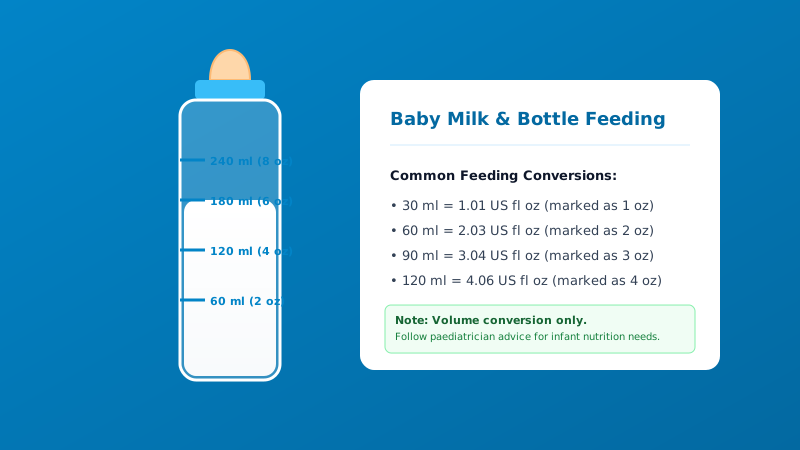
Baby bottles and milk storage containers often display measurements in millilitres. However, some feeding resources and bottle markings use fluid ounces.
Converting between these units helps parents understand bottle volume measurements.
Common Baby Milk Conversions
| Millilitres | US fluid ounces |
|---|---|
| 15 ml | 0.51 oz |
| 30 ml | 1.01 oz |
| 45 ml | 1.52 oz |
| 60 ml | 2.03 oz |
| 75 ml | 2.54 oz |
| 90 ml | 3.04 oz |
| 100 ml | 3.38 oz |
| 120 ml | 4.06 oz |
| 150 ml | 5.07 oz |
| 180 ml | 6.09 oz |
| 210 ml | 7.10 oz |
| 240 ml | 8.12 oz |
How Many Ounces Are in 60 ML?
60 ml equals approximately 2.03 US fluid ounces.
This is a straightforward volume conversion and does not indicate how much a particular baby should consume.
How Many Ounces Are in 120 ML?
120 ml equals approximately 4.06 US fluid ounces.
You may see this measurement on feeding bottles and milk storage containers.
How Do You Convert Breast Milk from ML to Ounces?
Use the same conversion formula used for other liquids:
For example, 150 ml of expressed breast milk equals approximately 5.07 US fluid ounces.
Does Breast Milk Have a Different Conversion Formula?
No. The volume conversion remains the same for breast milk, formula, water and other liquids.
Important Note About Baby Feeding
A volume converter only changes the measurement unit. It does not determine an appropriate feeding amount or feeding schedule.
Every baby has individual nutritional needs. Follow guidance from your baby's healthcare professional and the instructions provided with infant formula. Do not change formula mixing ratios based on a conversion estimate.
For quick measurements, use our Baby Milk ML to Ounces Calculator and Breast Milk ML to Ounces Calculator.