Millilitres, grams and ounces are commonly used in cooking, food preparation, product packaging and scientific measurements.
However, they do not all measure the same thing.
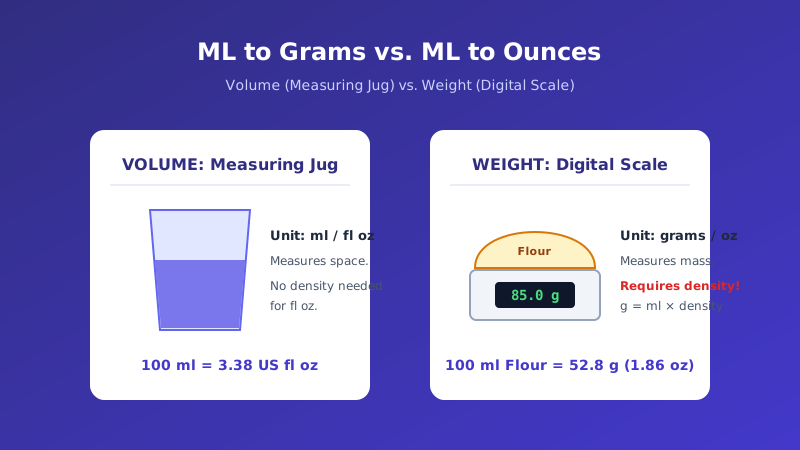
The main difference is that millilitres measure volume, while grams and weight ounces measure mass.
What Does ML Measure?
Millilitres measure the amount of space occupied by a liquid or substance.
For example:
- 100 ml of water.
- 250 ml of milk.
- 500 ml of cooking oil.
What Do Grams and Ounces Measure?
Grams and ounces measure mass or weight.
For example, a kitchen scale might show:
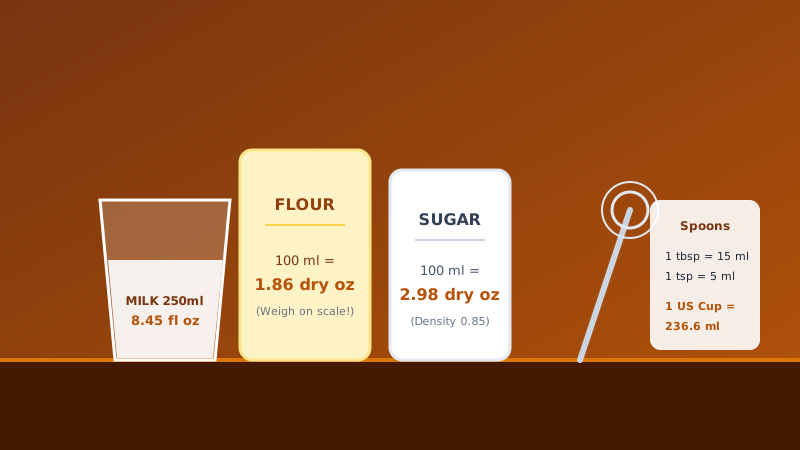
- 100 grams of flour.
- 200 grams of sugar.
- 500 grams of water.
Is 1 ML Equal to 1 Gram?
Not always.
For water, 1 ml has a mass close to 1 gram under ordinary conditions.
Other substances have different densities.
For example, honey is denser than water, while some cooking oils are less dense.
How to Convert ML to Grams
Use the density formula:
Example: If a liquid has a density of 0.85 g/ml:
100 × 0.85 = 85 grams
Therefore, 100 ml of that liquid weighs 85 grams.
How to Convert Grams into Weight Ounces
Use:
For the previous example:
85 ÷ 28.349523125 = 3.00 oz
How Is This Different from Fluid Ounces?
Fluid ounces measure volume, not mass.
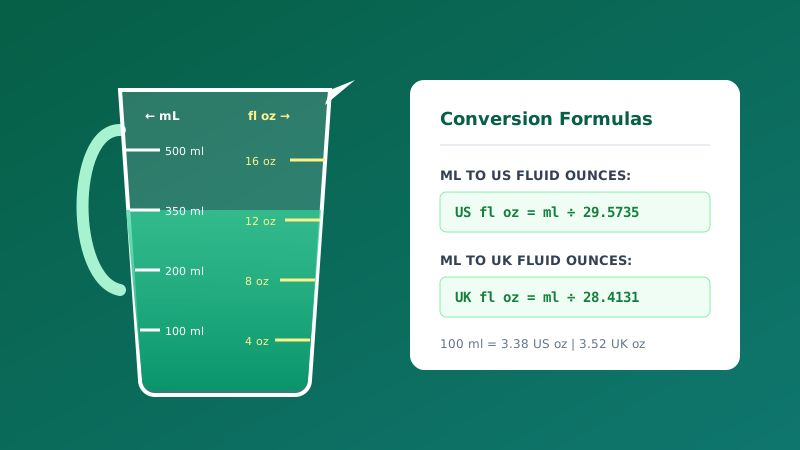
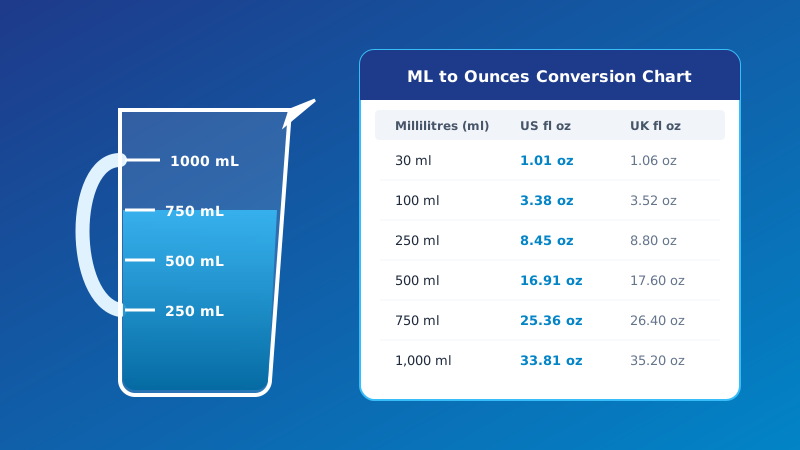
One US fluid ounce is approximately 29.5735 ml, whereas one weight ounce is approximately 28.3495 grams.
These conversions cannot be substituted for each other.
Which Calculator Should You Use?
- Use ML to Ounces for liquid volume.
- Use ML to Grams for volume-to-weight calculations requiring density.
- Use Grams to Ounces for weight conversion.
Try our ML to Grams Calculator and ML to Dry Ounces Calculator when you need to convert an ingredient's volume into weight.