Millilitres (ml) and fluid ounces (fl oz) are two commonly used units for measuring liquids. Millilitres belong to the metric system, while fluid ounces are used in the US customary and British imperial systems.
If you are following a recipe, measuring a drink, checking a bottle size or comparing product labels, knowing how to convert ml to ounces can make measurements easier.
The exact result depends on whether you use US or UK fluid ounces.
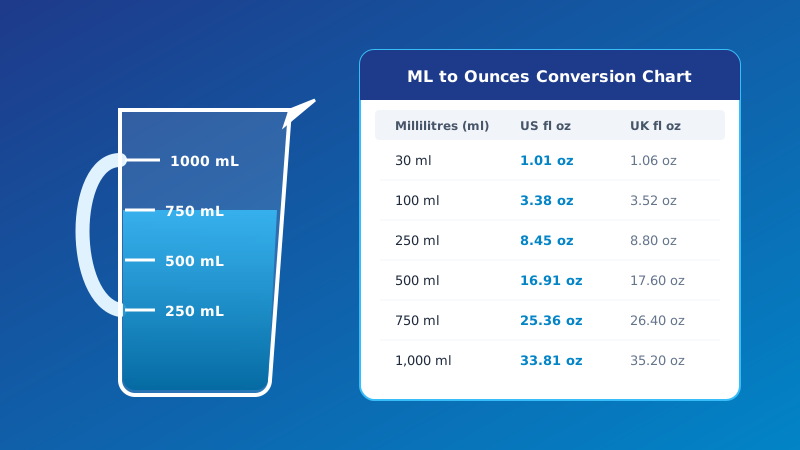
ML to US and UK Ounces Chart
| Millilitres | US fluid ounces | UK fluid ounces |
|---|---|---|
| 1 ml | 0.03 | 0.04 |
| 5 ml | 0.17 | 0.18 |
| 10 ml | 0.34 | 0.35 |
| 15 ml | 0.51 | 0.53 |
| 20 ml | 0.68 | 0.70 |
| 30 ml | 1.01 | 1.06 |
| 50 ml | 1.69 | 1.76 |
| 60 ml | 2.03 | 2.11 |
| 100 ml | 3.38 | 3.52 |
| 150 ml | 5.07 | 5.28 |
| 200 ml | 6.76 | 7.04 |
| 250 ml | 8.45 | 8.80 |
| 300 ml | 10.14 | 10.56 |
| 330 ml | 11.16 | 11.61 |
| 350 ml | 11.83 | 12.32 |
| 375 ml | 12.68 | 13.20 |
| 400 ml | 13.53 | 14.08 |
| 450 ml | 15.22 | 15.84 |
| 473 ml | 15.99 | 16.65 |
| 500 ml | 16.91 | 17.60 |
| 550 ml | 18.60 | 19.36 |
| 591 ml | 19.98 | 20.80 |
| 600 ml | 20.29 | 21.12 |
| 650 ml | 21.98 | 22.88 |
| 700 ml | 23.67 | 24.64 |
| 750 ml | 25.36 | 26.40 |
| 800 ml | 27.05 | 28.16 |
| 850 ml | 28.74 | 29.92 |
| 900 ml | 30.43 | 31.68 |
| 946 ml | 31.99 | 33.29 |
| 950 ml | 32.12 | 33.44 |
| 1,000 ml | 33.81 | 35.20 |
Values are rounded to two decimal places.
How to Convert ML to Ounces
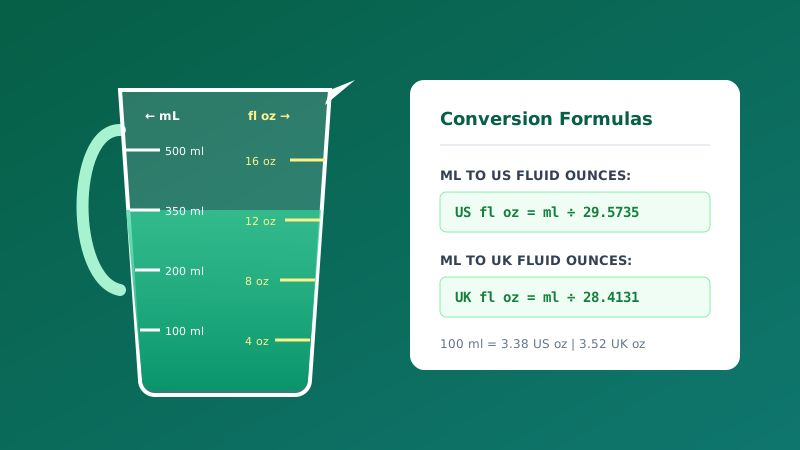
To convert millilitres into US fluid ounces, divide the volume by 29.5735296.
For UK imperial fluid ounces, divide by 28.4130625.
For example:
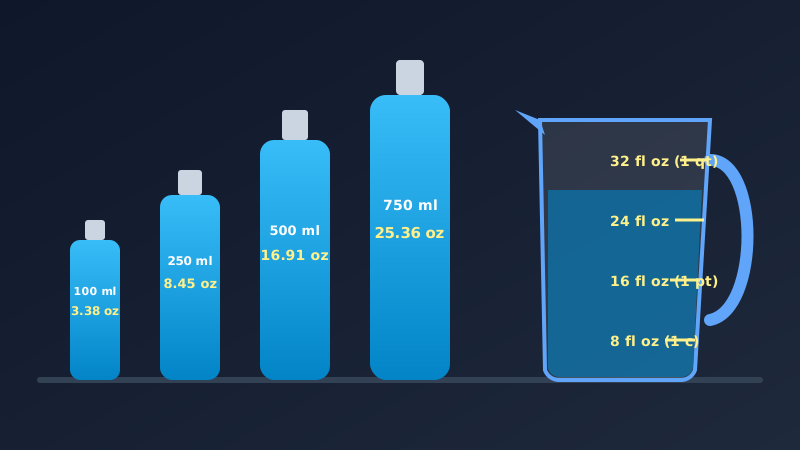
- 100 ml = 3.38 US fl oz
- 250 ml = 8.45 US fl oz
- 500 ml = 16.91 US fl oz
- 750 ml = 25.36 US fl oz
Why Are US and UK Fluid Ounces Different?
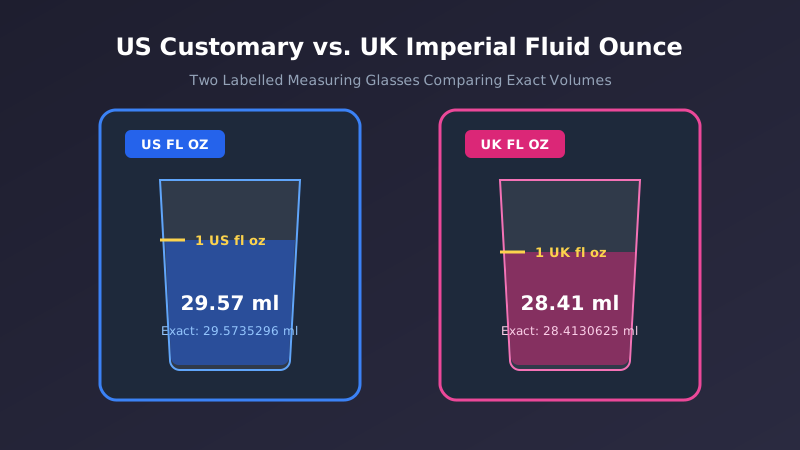
A US fluid ounce contains approximately 29.57 ml, while a UK imperial fluid ounce contains approximately 28.41 ml.
This means the same liquid volume produces a larger numerical result when expressed in UK fluid ounces.
When Should You Use an ML to Ounces Chart?
A conversion chart is useful when:
- Following international cooking recipes.
- Measuring water and other beverages.
- Comparing bottle sizes.
- Checking perfume and cosmetic packaging.
- Converting cocktail measurements.
- Reading liquid product labels.
For instant calculations, use our ML to Ounces Calculator.